Kitchen Pantry Designs That Maximize Food Storage and Improve Organization in Narrow Spaces
A narrow pantry is not a small pantry. It is a pantry whose shape works against you: shelves too deep to see into, gaps too slim for a standard cabinet, and a door that hides half of what you own. The good news is that narrowness itself is fixable, because the best kitchen pantry designs for tight spaces do not fight the shape — they use it.
The short answer: in a narrow space, shallow storage beats deep storage every time. A pantry that is one or two jars deep, with pull-out trays, door racks, and shelves sized to what you actually buy, holds more usable food than a deep cupboard twice its size — because everything in it stays visible, reachable, and in date.
Why a Narrow Pantry Fails Long Before It Runs Out of Room
Most narrow pantries do not lack cubic centimetres. They lack reachable centimetres. A shelf 60 centimetres deep holds two rows of tins, but the back row is invisible, so it becomes a graveyard of duplicate purchases and expired stock. A tall cupboard with fixed shelves wastes the top 20 centimetres of every shelf because jars are shorter than the gap above them. And a 15-centimetre gap beside the fridge looks like wasted space, when it is actually the perfect width for a pull-out pantry column.
Diagnose the problem before buying anything: depth you cannot see into, height you cannot use, or gaps you have written off. Each needs a different fix.
- Depth blindness: food disappears behind food, so you buy it twice and throw it away later.
- Wasted height: fixed shelves leave air above short jars that could hold another row.
- Dead gaps: filler strips beside appliances and awkward corners never given a job.
- Door amnesia: the inside of the pantry door, often the easiest extra shelf in the kitchen, left bare.
Measure the Gap Before You Buy a Single Basket
Pantry organisers come in standard sizes, but narrow kitchens are not standard. A basket two centimetres too wide will not fit, and a pull-out unit two centimetres too narrow wastes a strip of space for the life of the kitchen. Spend twenty minutes with a tape measure before spending anything else.
Measure the width, depth, and height of every candidate space — the cupboard interior, not the door front — and note pipes, hinges, or skirting that intrude.
Measure your tallest everyday items: cereal boxes, oil bottles, and pasta jars. Shelf spacing should follow your food, not the other way round.
Check the door swing: a door rack only works if the door still closes and nothing behind it is blocked.
Remember weight: tins and jars are heavy, and a narrow pull-out full of cans needs full-extension, heavy-duty runners, not the cheapest slides available.
The 15-Centimetre Column: Turning a Filler Gap Into Your Main Pantry
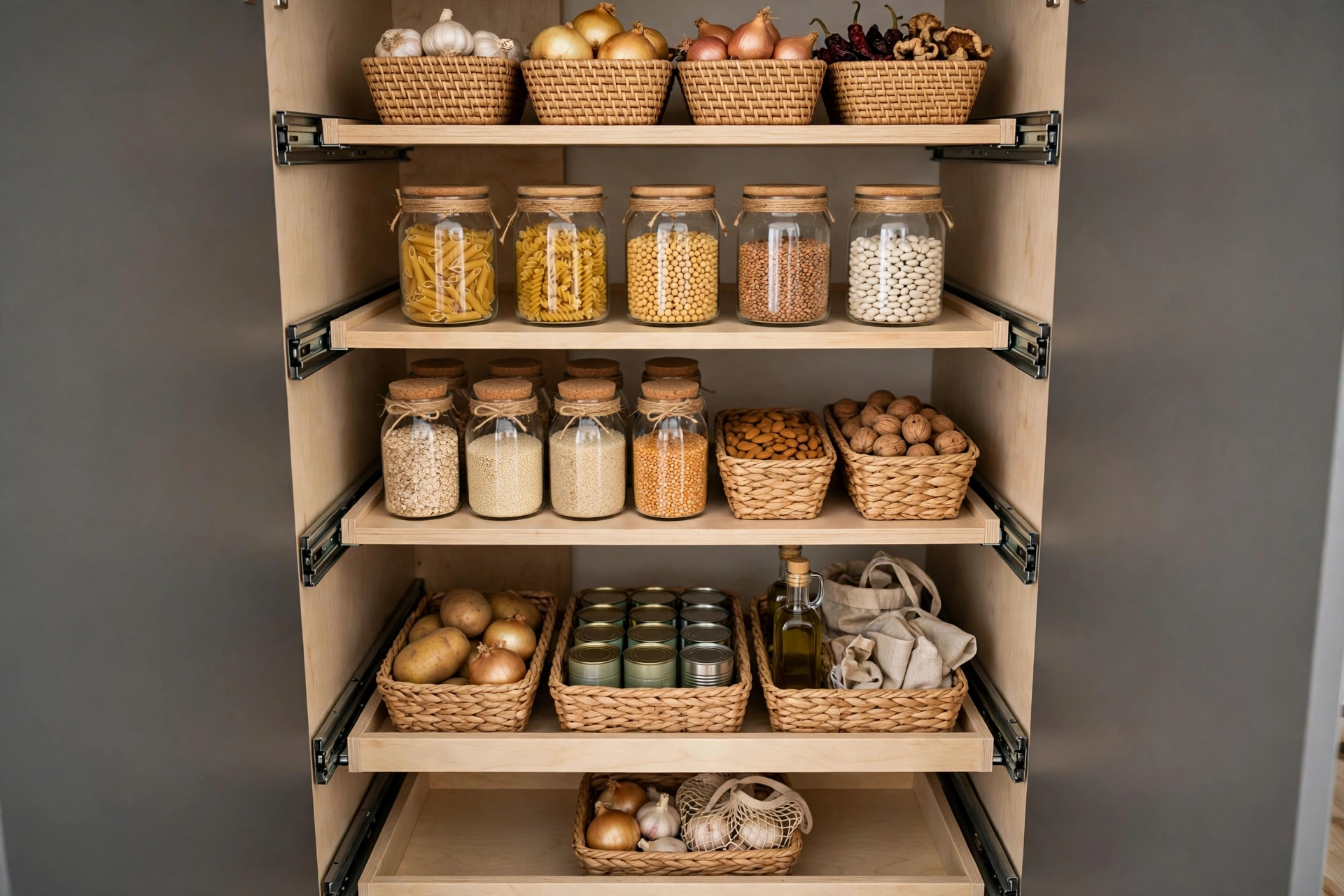
The single most effective pantry design for a narrow kitchen is the tall pull-out column: a slim vertical unit, typically 15 to 30 centimetres wide, that slides out on full-extension runners to reveal shelves you can see from both sides. It fits in the filler gap beside a fridge or cooker, at the end of a run of cabinets, or in a shallow closet never deep enough for a real cupboard.
Because you approach the shelves from the side rather than the front, nothing hides behind anything else. Spices, oils, tins, and jars each get a shelf sized to their height, and the whole column pulls out far enough that the back of every shelf is as reachable as the front. Choose adjustable shelves and a non-slip liner so bottles stay upright, and keep the heaviest items on the lowest baskets, where the weight sits low and the runners last longer.
Shallow Beats Deep: Shelving That Shows Every Jar at a Glance
If you have a reach-in pantry closet rather than a pull-out column, the same rule applies: make the shelves shallow. Food stored one or two jars deep stays visible, so you use what you have before it expires and stop buying duplicates. Where existing shelves are deep, pull-out trays or sliding baskets inside the cupboard give you the same effect without rebuilding anything — you pull the tray toward you instead of reaching into the dark.
Tiered can risers work the same way for tinned food: the back row sits higher, like stadium seating, so every label is visible. For packets, a narrow upright bin keeps them standing like files in a drawer.
- One jar deep is ideal; two jars deep works if the front row is short and the back row tall.
- Adjustable shelf heights beat fixed shelves, because your food changes size more often than your kitchen does.
- Clear containers help only if they share one footprint — a jumble of different tubs wastes more space than the packets they replaced.
Door, Wall, and Kick-Plate: Storage Hiding in Plain Sight
A narrow kitchen usually has three surfaces not used for food at all: the inside of the pantry door, a stretch of bare wall, and the kick-plate beneath the base cabinets. Door-mounted racks hold spices, small jars, and snack packs at eye level the moment you open the door — just keep heavy items off the door, since overloaded racks strain hinges over time, and check the rack clears the shelves when the door closes.
A wall rail with hooks and small baskets does similar work for oils and utensils, and a shallow floating shelf above a worktop can hold everyday jars where you reach them mid-recipe. Toe-kick drawers, the shallow drawers in the plinth beneath base cabinets, are the most overlooked of all: too shallow for tins, but perfect for baking trays and boards.
One Home for Every Category: Zoning a Narrow Pantry by How You Cook
A pantry stays organised when every category has exactly one home, and that home is where you reach for it. Grouping by how you cook — breakfast, everyday cooking, baking, snacks — works better than grouping alphabetically, because you grab a whole zone at once instead of hunting across five shelves for one meal.
Label every zone, even if you live alone — labels stop a tidy pantry drifting back into a jumble.
Decanting, Labelling, and the One-In-One-Out Rule That Keeps It Working
Decanting dry goods into clear, square containers is worth doing in a narrow pantry for one reason: uniform containers pack without gaps, while a mix of boxes and bags leaves air pockets everywhere. Keep the original packet’s cooking instructions and expiry date on a label, and only decant what you will use within a few weeks so food stays fresh.
Protect it with the one-in-one-out rule: when a new non-perishable comes in, something old, duplicate, or expired goes out. Pair it with a five-minute weekly sweep — older items forward, dates checked — and a narrow pantry stays organised with almost no effort.
Narrow-Pantry Layouts for Galley, L-Shaped, and Single-Wall Kitchens
The right pantry design depends on the shape of the kitchen around it. In a galley kitchen, the pull-out column is king: it slides into the run without needing door swing, and a second slim unit on the opposite run balances storage without narrowing the walkway. In an L-shaped kitchen, the corner is the problem — a blind corner cupboard hides food — so put the pull-out column in the cabinet beside the corner and relegate the corner itself to bulky, rarely used equipment that does not mind the dark.
In a single-wall kitchen, a tall pantry wall at one end of the run — shallow, full-height cabinets — replaces the uppers you lack room for, with a pocket or bifold door keeping it accessible. In all three layouts, keep the pantry near the prep zone.
Narrow-Pantry Slip-Ups That Cost You Space Twice
The most common narrow-pantry mistake is buying storage before measuring, which produces organisers that do not fit and shelves that still waste height. The second is overfilling: a pull-out column packed to the brim slides badly, strains its runners, and hides the very items it was bought to reveal. Leave a little air at the top of every shelf — the pantry works better slightly under-filled than crammed.
A third slip-up is mixing food with cleaning products in the same unit — chemicals belong in their own cabinet, for safety and because one leaking bottle can ruin a shelf of dry goods. And a fourth is forgetting light: a small battery light inside a deep cupboard often does more than another basket.
What a Narrow Pantry Makeover Costs, Roughly
A narrow pantry makeover can cost very little or a great deal, and the difference is mostly whether you retrofit or rebuild. The figures below are broad estimates, not quotes — prices vary by region, material, and whether you fit things yourself — but they show the order of magnitude for each approach.
When a Narrow Pantry Job Belongs With a Joiner or an Electrician
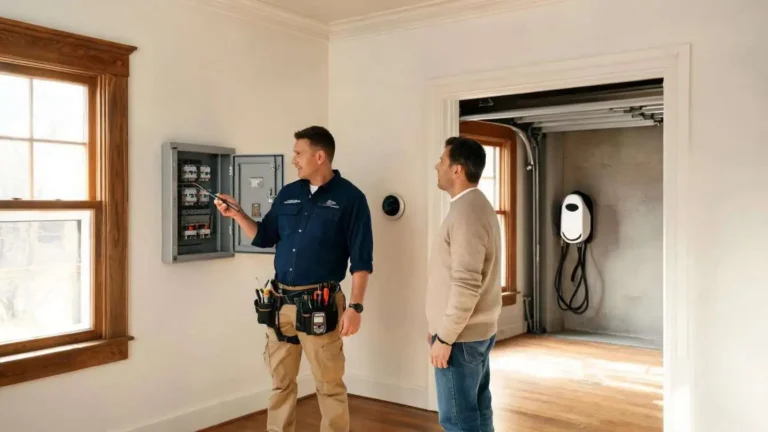
Most narrow pantry organisation is safe DIY work: measuring, fitting door racks, and sliding baskets into existing cabinets need no qualifications. The line is crossed when the job changes the structure or the electrics. Cutting into a wall to create a recessed pantry, moving a stud, or altering a load-bearing partition belongs with a qualified joiner or builder, and any new socket, light, or appliance point inside a pantry needs a qualified electrician — damp and heat make pantry electrics a poor place to improvise.
Also call a professional if you find damp, mould, or pests behind a pantry unit: fix the cause first, then fit the storage. In older homes, check for lead paint before sanding painted surfaces, and leave suspected asbestos to a licensed specialist.
Narrow Pantry Questions Homeowners Ask Before Reorganising
How wide does a pull-out pantry column need to be?
Most slim pull-out units fit gaps of about 15 to 30 centimetres, with 15 centimetres as a practical minimum for spices, oils, and tins. Wider units hold more, but the narrow ones are often the most useful because they fit the gaps other storage cannot use. Measure your gap, then buy the unit to fit it.
Are deep pantry shelves ever a good idea in a narrow kitchen?
Deep shelves work only when fitted with pull-out trays or sliding baskets, so you bring the back of the shelf to yourself instead of reaching into it. Without pull-outs, a deep shelf in a narrow kitchen is the fastest way to lose food at the back.
Should pantry food be decanted into containers?
Decanting helps in a narrow pantry because uniform square containers pack without gaps, and you can see at a glance what needs restocking. It is not essential, though — labelled baskets and upright packet files achieve much of the same effect with less work, and they suit renters better.
Where should heavy items go in a tall narrow pantry?
At the bottom. Heavy tins, bulk rice, and flour belong on the lowest shelves or baskets, where the weight sits low, the unit stays stable, and you are not lifting heavy loads from shoulder height.
Can a narrow pantry hold small appliances too?
It can, if you plan a counter-height niche or an appliance garage into the design, with a socket fitted by an electrician. Without a dedicated spot, appliances tend to colonise the worktop, which defeats the purpose of the pantry in a small kitchen.
How do I stop a newly organised narrow pantry from sliding back into chaos?
Give every category one labelled home, follow the one-in-one-out rule for new purchases, and do a five-minute weekly sweep to pull older items forward and check dates. Narrow spaces punish clutter faster than large ones, so the habit matters more than the hardware.
A Narrow Pantry That Finally Feeds the Kitchen Instead of Fighting It
A narrow kitchen does not need a bigger pantry. It needs one designed around what narrowness allows: shallow shelves you can see into, a pull-out column that turns a filler gap into prime storage, and zones that match how you cook. Measure first, buy second, and let the habit — one home per category, older stock forward, one in and one out — do the long-term work.